
For card operations, disputes and customer outcomes teams at Australian card issuers who need every dispute answered inside the ePayments Code timeframes.
Key takeaways
- On 18 June 2026 the Federal Court ordered HSBC Bank Australia to pay a $35 million penalty for scam protection failures. ASIC said the bank took 144 days on average to investigate customers' scam reports.
- Under the ePayments Code, a card issuer has 21 days to answer a dispute and 45 days to finish it.
- A single dispute touches six systems. Agento runs it as one workflow of 24 steps across five apps, with two approvals from a dispute officer.
- In the sandbox run in the video, the card was frozen 5.9 seconds after the customer's report arrived.
144 days, against a 45-day limit
ASIC's case concerned how the bank handled reports of unauthorised transactions. Between January 2020 and August 2024 it received more than 1,000 reports totalling $34.6 million, and took 144 days on average to investigate them. The court found the failures were widespread and systemic.
The ePayments Code sets the benchmark that case was measured against: respond within 21 days, and complete the investigation within 45. The reason issuers miss it is rarely the rule itself. It is the amount of manual work between a customer's report and a finished case.
Today, one dispute touches six systems
- Card platform: find the transaction and freeze the card.
- Card scheme: check eligibility and lodge the chargeback.
- CRM: open the case and record every decision.
- Regulation: work out liability under the ePayments Code.
- Email: send a letter with the clause and the customer's AFCA rights.
- Team chat: tell the dispute officers.
Each of those is done by hand, by different people, against the clock.
One workflow instead
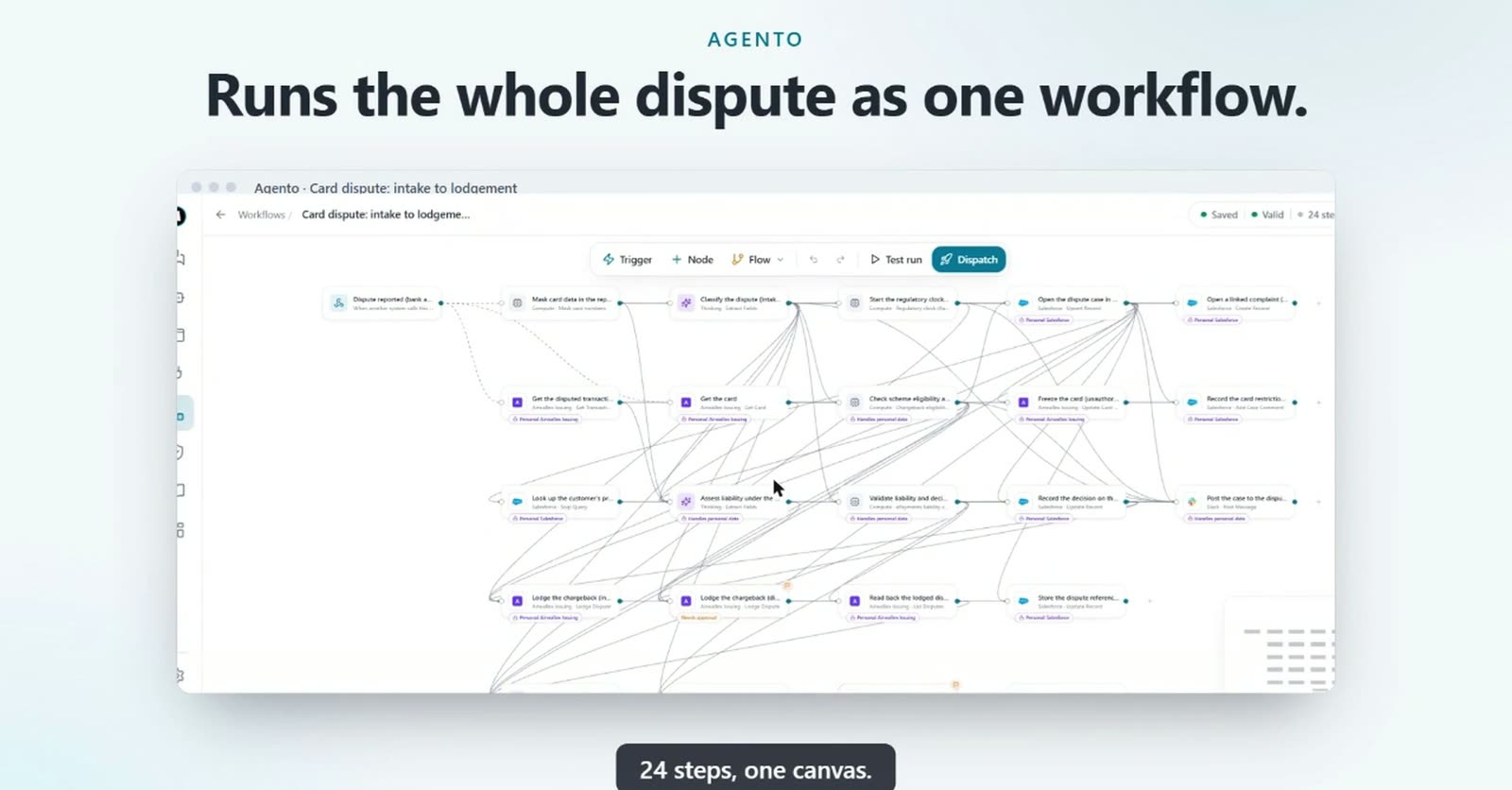
Agento runs the whole dispute as one workflow. The intake-to-lodgement workflow in the video has 24 steps on one canvas.
Connected once
Each tool is authorised once on the Connectors page and every workflow can then use it:
- Airwallex Issuing for cards, freezes and disputes.
- Mastercard Mastercom for claims and chargebacks.
- Salesforce as the case of record.
- Gmail or Outlook for customer letters.
- Slack or Teams for alerts to dispute officers.
Built-in skills for the regulated parts
- Mask card data. Card numbers are masked before any AI model sees the report.
- Classify the dispute. Unauthorised, merchant, scam or complaint, with a confidence score.
- Australian regulatory clock. The 21 and 45-day deadlines, allowing for business days and state holidays.
- Scheme eligibility. Filing window, chip and 3-D Secure liability shift, and reason code.
ePayments liability check.The AI's assessment is checked against the Code's clause table.- Regulated letter check. The clause is cited, AFCA rights are included and no card numbers appear.
Steps that carry risk wait for a dispute officer to approve them.
A live sandbox run
The video shows the workflow running against a sandbox card.
1. A customer reports a purchase they didn't make
The customer writes that they did not make a $2,400 purchase and their card details were stolen. The bank's app sends the report to Agento as a signed webhook and the run starts on its own.
2. The card is frozen automatically
Agento freezes the card on Airwallex in 5.9 seconds. This happens automatically for unauthorised claims only.
3. Liability is assessed and an officer signs off
Agento assesses liability under the ePayments Code. In this run the result is that the customer is not liable, with the clause recorded. The run then waits for a dispute officer to sign off.
4. The chargeback is lodged
Once the officer approves, the chargeback is lodged with Airwallex for $2,400 with the reason suspected fraud. In the run it was created and submitted two seconds apart.
5. The letter is checked, approved and sent
Agento drafts the customer letter and checks it: the clause is cited, the customer's AFCA complaint rights are included and no card numbers appear. An officer approves it and it is sent.
The finished run: 24 steps, 5 apps, 2 officer approvals, with every step recorded and nothing copied by hand.
Two more workflows finish the job
- Merchant response and outcome. When the merchant responds, a second workflow picks the case up. It stops until the scheme has decided, then records the outcome and closes the case.
- Daily clock watcher. Every morning at 8:00 am Sydney time, a third workflow checks every open case against its 21 and 45-day clocks. For each case two days from a deadline it drafts and checks an extra-time notice and creates a task for an officer.
Start from a template
The three workflows are available as templates under Banking and Financial Services. You can edit the steps, approvals and conditions on the canvas, or describe the change in plain English. The apps can be swapped, for example Gmail and Slack for Outlook and Teams.
Issuing on Mastercard instead? The same flow runs through Mastercom, finding the transaction by its acquirer reference number.
What changes for the disputes team
- Cards frozen in seconds on unauthorised claims, not after a queue.
- Clocks in code. Each case carries its 21 and 45-day deadlines from the moment it opens.
- Officers approve the risky steps. Liability and the customer letter both wait for a person.
- Letters checked before they go. Clause, AFCA rights and no card numbers, every time.
- A full record. Every step, decision and approval is kept for QA, AFCA or ASIC.
How much time this saves depends on your dispute volumes, card platform and case setup. We scope each rollout against your current process before quoting outcomes.