

Part of our air-gapped and on-premise AI series, which describes how we deliver private deployments with customers.
What a knowledge graph is
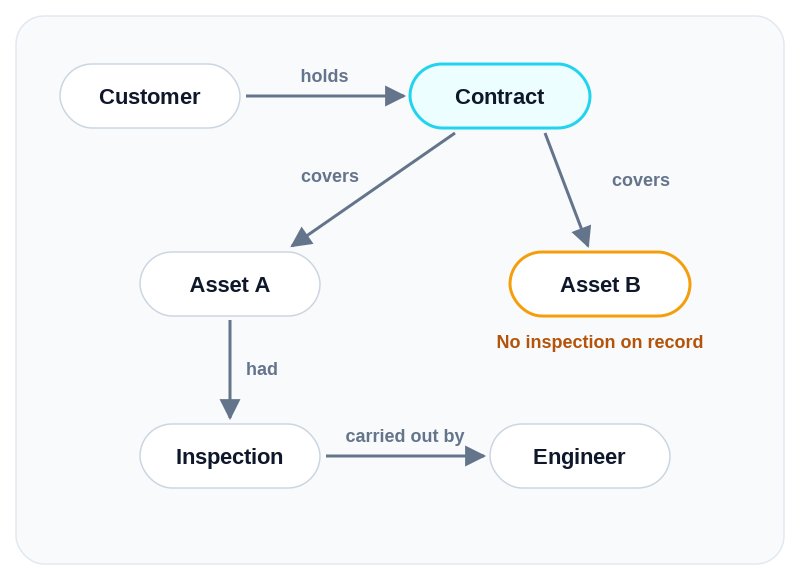
Most business information is stored as separate records: a customer here, a contract there, an asset somewhere else. A knowledge graph stores the things and the links between them.
- This customer holds this contract.
- This contract covers these assets.
- This asset was inspected by this engineer on this date.
Each fact is small. Together they form a map of how the organisation fits together.
Why AI needs the map
A language model is good with words and knows nothing about your business. Giving it documents helps when the answer sits in one document. It helps less when the answer is spread across many.
Take the question: which assets under the northern maintenance contract are overdue for inspection? No single document says. The answer comes from following links: contract to assets, assets to inspections, inspections to dates. A knowledge graph lets the model follow them instead of guessing.
Research supports this. A 2024 paper from Microsoft Research reported that building a graph of entities from a body of documents gave more complete and more varied answers to questions about the collection as a whole than retrieving passages alone (Edge and others, 2024).
What it changes in a workflow
- Fewer wrong answers. The model works from recorded facts and links, not from what sounds likely.
- Answers you can check. Each answer can point to the records and links it used.
- Questions that span departments. Accounts, contracts and engineering can be asked about together.
- Access that follows the map. A model, or a person, can be limited to the part of the graph they are allowed to see.
How it fits with specialist models
In a private deployment, specialist models each look after one area. The knowledge graph is what connects the areas. When the core model needs to know which contract an invoice belongs to, the graph tells it, and points to the specialist to ask next.
Graphs and fine-tuning do different jobs. Facts that change, such as who owns an asset today, belong in the graph. Skills that stay stable, such as how to read your style of contract, are what fine-tuning is for.
What it takes to build one
A useful graph does not need to cover everything.
- Pick the questions. Start from the workflows you want to run and the questions they ask.
- Name the things and links. Customers, contracts, assets, people, and how they relate.
- Load from your systems. The facts come from records you already hold.
- Keep it current. A graph is only as good as its last update, so it is refreshed as your systems change.
- Grow it as needed. Add a new area when a new workflow needs it.
The honest limits
- A graph reflects the quality of the data behind it. Gaps and errors carry through.
- Deciding what to model takes people who know the business.
- It needs upkeep, like any other system of record.
How Agento approaches it
Agents in Agento already work with the knowledge you give them. For a private deployment, we build a knowledge graph from your own systems where your workflows need one, starting with the first few questions and growing from there. It stays inside your environment with the rest of the deployment, and what an agent can reach through it follows your permissions.
This is delivered as part of a scoped private deployment. See air-gapped and on-premise AI.