

Part of our air-gapped and on-premise AI series, which describes how we deliver private deployments with customers.
One model is not the only option
Most people meet AI as a single large model that answers everything. Inside a business, that is rarely the best design. A workflow touches accounts, contracts, engineering records and customer history, and each of those has its own language and rules.
The alternative is a team of models. A core model runs the workflow. When a step needs knowledge from one part of the business, the core model asks a model that specialises in it. We call this specialist model calling.
How the pattern works
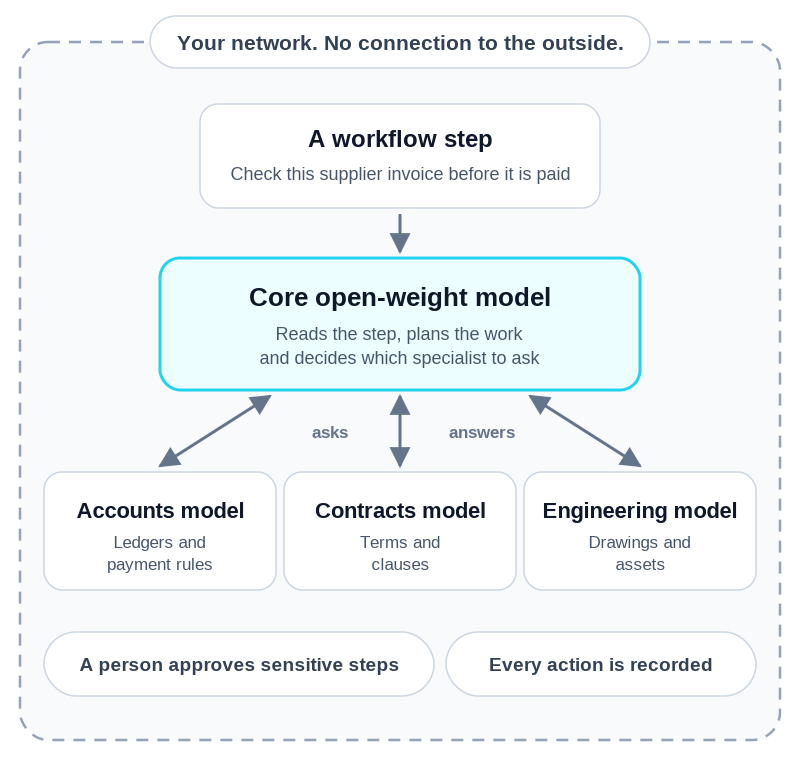
- A workflow step arrives. For example: check a supplier invoice before it is paid.
- The core model reads it. It works out what the step needs and which specialist can help.
- It asks the specialist. A question about payment terms goes to the accounts model. A question about what the contract allows goes to the contracts model.
- The specialist answers from what it knows. Its answer goes back to the core model.
- The core model puts the result together and moves the workflow to its next step, or to a person for approval.
Every call travels over your internal network. In an air-gapped deployment there is nowhere else for it to go.
An example: paying a supplier invoice
| Step | Who handles it | What it draws on |
|---|---|---|
| Read the invoice | Core model | The document itself |
| Match it to the purchase order | Accounts model | Your ledger and supplier records |
| Check the rate against the contract | Contracts model | Your agreed terms |
| Confirm the work was delivered | Engineering model | Site and asset records |
| Approve payment over a set amount | A person | The evidence gathered above |
The models and their names here are examples. In practice the specialists follow the shape of your organisation.
Why specialists help
- Better answers on your own material. A small model set up for one area of your business can beat a much larger general model on that area.
- Less hardware. Small models are cheap to run. Researchers have argued that small language models are capable enough, and more economical, for much of the routine work that AI agents do (Belcak and others, 2025).
- Clear boundaries. The accounts model can be the only model allowed to see the ledger. Access follows the structure of the business.
- Easier to improve. You can retrain or replace one specialist without touching the rest.
What the core model does
The core model is the coordinator. It does not need to know everything. It needs to understand the step in front of it, know which specialists exist and what each is for, and combine their answers. That is a reasoning job, so the core model is usually the larger one.
When one model is enough
Not every organisation needs a team of models on day one. If your first workflows sit in one part of the business, a single good open-weight model with access to the right documents may do the job. Specialists earn their place when testing shows a general model falling short in one area, or when access to an area needs to be tightly controlled.
How Agento approaches it
Agento already chooses a suitable model for each step in its cloud service. In a private deployment we apply the same idea to models you host. We work out with you which workflows need a specialist, set each one up for its area, and test the whole team against real work before it goes live. Approvals and the audit trail apply to every step, whichever model did the work.
This is delivered as part of a scoped private deployment. See air-gapped and on-premise AI for how that runs, fine-tuning for how a specialist is trained, and data knowledge graphs for how the models find the right facts.