

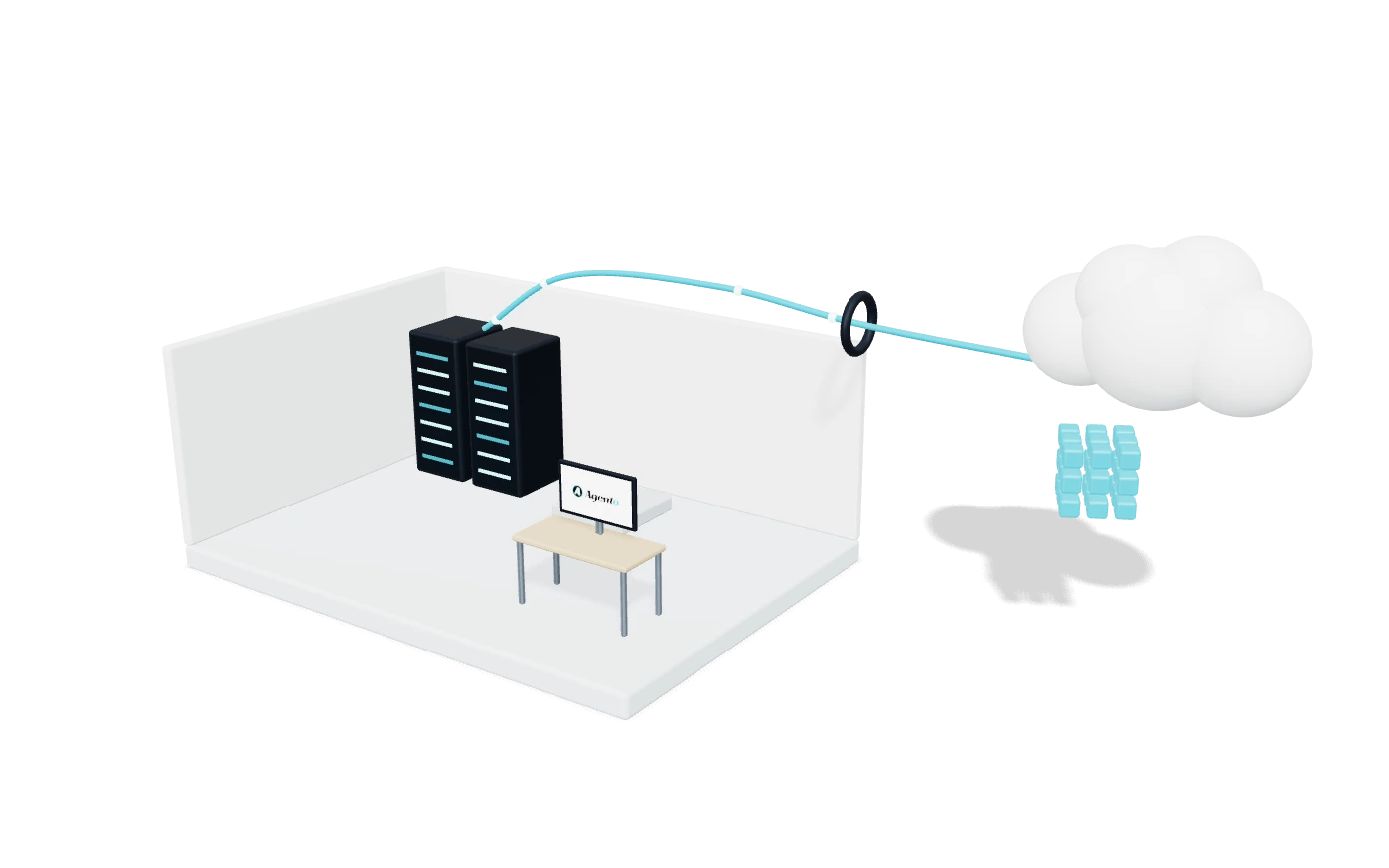
- Agento deployed on-premise or in your own cloud account
- Your own private models connected to your workflows
- A person approving sensitive steps before they run
- A tamper-evident audit trail you can review and export
Private & Sovereign AI
How we deploy Agento inside your own walls, on open-weight models you host and control.
Where this stands today
We would rather be plain about this than oversell it. Some of what is on this page is available now. The rest is how we deliver a private deployment with you.
- Fully disconnected (air-gapped) operation, with no outbound connection
- Open-weight models running on your own hardware
- Specialist models and fine-tuning for your tasks
- A knowledge graph built from your own data
These are delivered as an Enterprise project, not switched on from a settings page. We agree the scope, the hardware and the acceptance tests with you before work starts.
Three ways to run Agento
Most organisations that ask for "air-gapped" need one of the two private levels. The right one depends on what your data is allowed to touch.
| Aspect | Agento Cloud | Private deployment | Air-gapped deployment |
|---|---|---|---|
| Where it runs | Our hosted service, in an Australian region | Your data centre or your own cloud account | Your own servers, on a network with no outside connection |
| Outbound connections | Yes | Only to destinations you approve | None |
| AI models | Leading models, chosen for each step | Your private models, or providers you approve | Open-weight models on your hardware |
| Works with | Cloud and on-site tools | The cloud and on-site tools you approve | On-site systems only |
| Suits | Most businesses | Regulated work and data that must stay in-country | Classified, defence and critical infrastructure work |
| Status | Available now | Available on Enterprise | Scoped and delivered with you |
How it works, in concept
A workflow is a series of steps. In a private deployment, a core open-weight model reads each step and works out what it needs. When a step calls for specialist knowledge, the core model asks a specialist model over your internal network. A step about a supplier payment goes to the accounts model. A step about a clause goes to the contracts model.
Each model does the part it is best at, and nothing leaves the boundary.
Your network. No connection to the outside.
A workflow step
"Check this supplier invoice against the contract"
Core open-weight model
Reads the step, plans the work and decides which specialist to ask
Accounts model
Your ledgers, suppliers and payment rules
Contracts model
Your terms, clauses and obligations
Engineering model
Your drawings, standards and assets
Your systems and data. Read and updated in place.
A person approves anything sensitive before it runs.
Every action is recorded in the audit trail.
Open weight is the key
An open-weight model is one whose trained weights are published, so you can download it and run it on your own hardware. That is what makes a real air gap possible. A model you can only reach through someone else's service cannot run on a network with no outside connection.
It runs where your data is
The model sits on your servers, so prompts, documents and answers never cross your network boundary.
It is yours to keep
A provider cannot change it, reprice it or retire it underneath you. You decide when to move to a newer version.
It can be specialised
You can fine-tune it on your own material, on your own hardware, and the result stays with you.
It comes in every size
From small specialist models that run on one server to large general models. We use the smallest one that passes your tests.
The trade-off is real. You take on the hardware and the upkeep, and the largest cloud models are still stronger at the hardest open-ended reasoning. That is why we test models against your own workflows before recommending one.
What stays the same, and what changes
The governance stays the same
You still describe a process in plain language and Agento runs it. Permissions decide who can do what, a person approves sensitive steps, and every action lands in an audit trail you can export. None of that depends on an outside connection.
The connections change
Tools that live in someone else's cloud, such as cloud email or a cloud CRM, cannot be reached from a network with no outside connection. In an air-gapped deployment Agento works with the systems you run on site.
How we deploy this with you
A private deployment is a project with your security and infrastructure teams, not a download.
- 1
Scope
We agree which workflows come first, what data they touch, which deployment level you need and the tests that will prove it works.
- 2
Choose and size the models
We test candidate open-weight models against your real workflows and size the hardware around the ones that pass.
- 3
Install and prove
Agento is installed inside your network. Your security team runs the acceptance tests, including a check that nothing connects out.
- 4
Operate and update
New versions and new models arrive as packages you verify and bring in through your own change process, on your schedule.
Go deeper
Each part of the approach has its own page.
How the approach works
Open-weight models explained
What open weight means, how it differs from open source and closed AI, and why it matters for private deployment.
Read moreSpecialist models that call each other
A core model runs the workflow and asks specialist models when a step needs their knowledge.
Read moreFine-tuning for specialised tasks
When fine-tuning is worth it, what it needs from you, and what to try first.
Read moreData knowledge graphs
Giving private AI a map of how your customers, assets, contracts and people connect.
Read moreOwning your own models
Control, continuity, cost and the asset you build when the model is yours.
Read moreGoverning AI inside the air gap
Approvals, permissions and audit trails when there is no outside connection.
Read moreThe wider picture
Data sovereignty and AI
Why where the model runs matters, and what the rules say.
Read moreSafe use of AI: the cybersecurity view
What national cybersecurity agencies recommend for AI systems.
Read moreAI in government: the Australian perspective
What Australian policy asks of agencies and their suppliers.
Read moreHow governments are moving to air-gapped and on-premise AI
Dated examples from Australia, the United States, Europe and the Gulf.
Read moreThe white paper
Everything in this section in one document, with the references, for your security and procurement teams.
Version 1.0, 29 November 2026. PDF.
Questions we are asked
What is the difference between on-premise and air-gapped?
On-premise means Agento runs on your own servers or in your own cloud account, and may still reach outside services you approve. Air-gapped means the network it runs on has no outside connection at all, so every part, including the AI models, has to run inside.
Is air-gapped Agento available today?
On-premise and own-cloud deployment is available on Enterprise today. A fully disconnected deployment on open-weight models is delivered as a scoped project with your team. We agree the scope, hardware and acceptance tests with you before work starts.
Do you use small models or large ones?
Whichever passes your tests. Open-weight models range from small specialist models to large general ones. We start with the smallest model that does the job well, because it is cheaper to run and easier to host, and use a larger one where the work needs it.
Will a local model be as good as the leading cloud models?
For well-defined workflow steps, a good open-weight model is often enough, and a specialised one can be better on your own material. For the hardest open-ended reasoning, the largest cloud models are still stronger. We test against your real workflows and tell you what we find.
Do the models need fine-tuning?
Usually not at the start. Clear instructions, your own documents and structured outputs go a long way. We recommend fine-tuning only when testing shows a repeated gap that those cannot close.
What hardware do we need?
It depends on the models and the amount of work. Open-weight models need servers with graphics processors. We size the hardware with you during scoping, after testing models against your workflows.
Which certifications does Agento hold?
Our current compliance status is set out in the Trust Center. We do not claim certifications we do not hold. Open the Trust Center.
Tell us what cannot leave your network
Send us the workflows you have in mind and the rules your data has to follow. We will tell you which deployment level fits and what it would take.
Last updated 29 November 2026