

Part of our air-gapped and on-premise AI series, which describes how we deliver private deployments with customers.
An air gap solves one problem
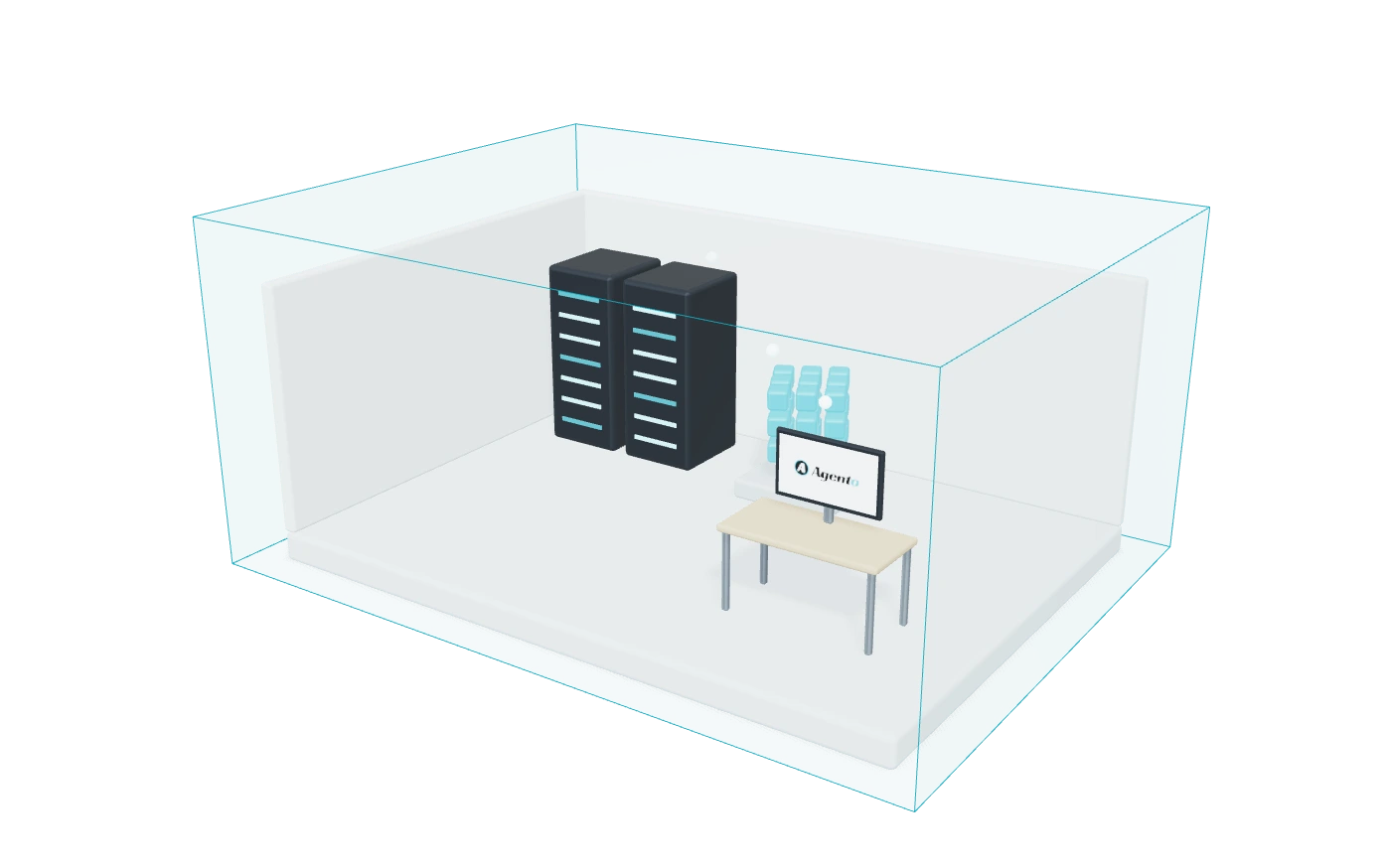
Taking a network offline answers the question of where your data can go. It cannot go anywhere. That is a strong protection, and it is why defence and critical infrastructure rely on it.
It does not answer a second question: what is the AI allowed to do inside? An AI agent on a disconnected network can still update the wrong record, approve something it should not, or act on a document that was written to mislead it. The damage stays inside, but it is still damage.
So a private deployment needs two things: the boundary, and the governance within it.
What governance means here
Permissions
Each agent can only reach the systems and data its job needs. An agent that drafts replies does not need to change payment details.
Human approval
Sensitive steps stop and wait for a named person. Paying money, changing a record or sending something outside the team should not happen on a model's say-so.
An audit trail
Every action is recorded: what was done, on what, and on whose approval. The record is tamper-evident, so it can be relied on later.
Limits and a stop
Agents work within set limits, and a person can halt them. AI agent guardrails explains how.
These are part of Agento today, in its cloud service. They belong to the platform itself, so they apply in a private deployment in the same way.
Why this matters more offline, not less
On a disconnected network, your own team is the only line of oversight. No provider is watching for misuse and there is no outside monitoring. The record of what the AI did has to be complete, and it has to be yours.
Three risks remain inside an air gap:
| Risk | What it looks like | What controls it |
|---|---|---|
| Misleading input | A document contains text written to steer the AI | Limited permissions, and approval on sensitive steps |
| Too much access | An agent can reach data its job does not need | Permissions set to the task |
| No record | Nobody can show what the AI did or why | A complete audit trail |
Security agencies make the same points about AI systems in general. Safe use of AI: the cybersecurity view sets out their guidance.
Evidence that stays inside
Auditors and regulators will ask for proof. In a private deployment the audit trail is stored in your environment with everything else. You can review it and export it for your own audits without anything leaving your network.
Keeping it governed over time
- Updates. New versions and new models come in through your own change process and are tested before use.
- Model changes. A new or re-tuned model is checked against the same test workflows before it replaces the old one.
- Access reviews. Who and what can take which actions is reviewed like any other system access.
How Agento approaches it
Governance is the part of Agento that exists today, and we would not deliver a private deployment without it. Workflows, permissions, approvals and the audit trail work the same way wherever Agento runs. What changes in an air-gapped deployment is the models underneath and the systems it connects to, which we scope with you.
See air-gapped and on-premise AI for the deployment levels.